
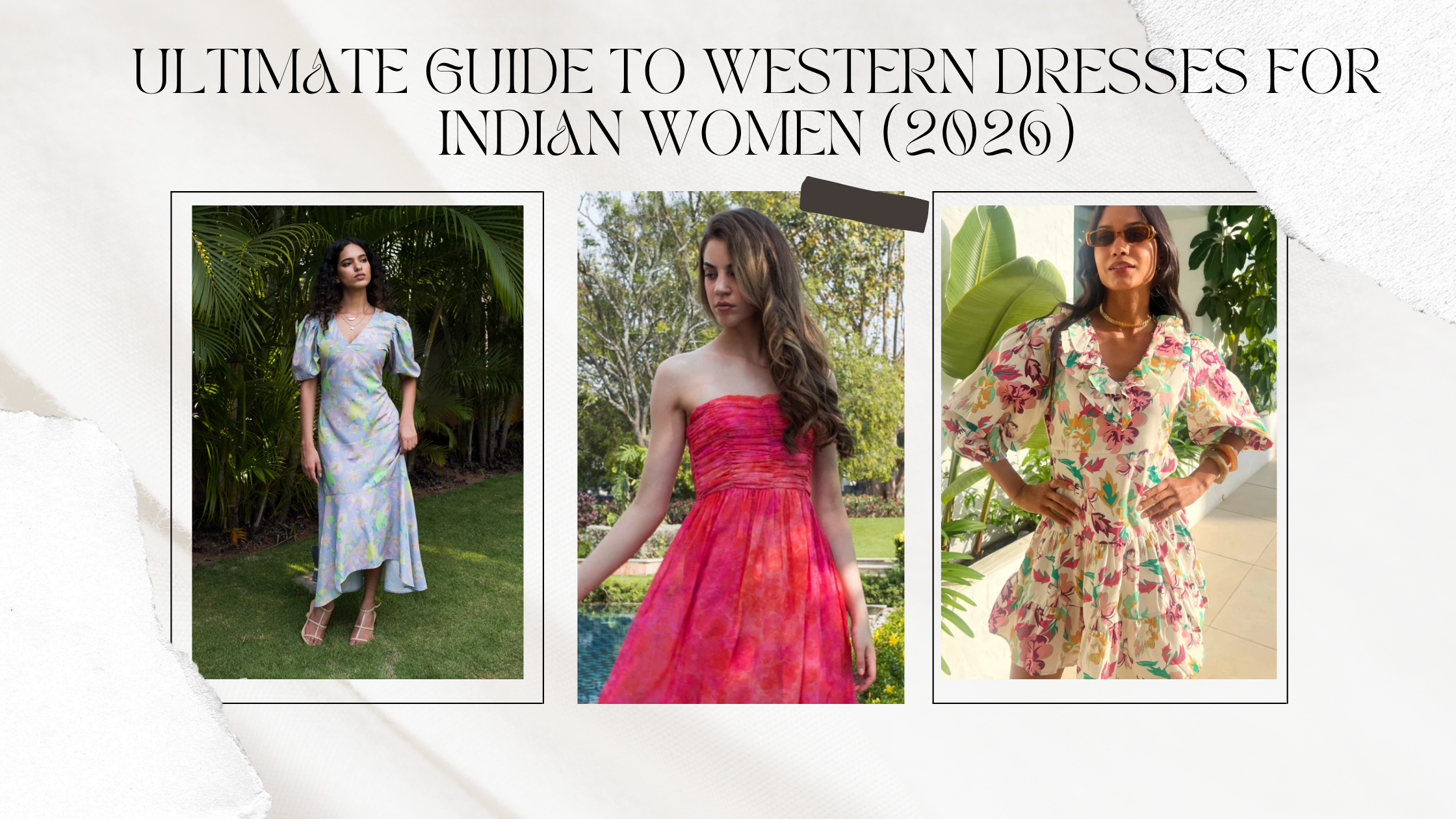
Ultimate Guide to Western Dresses for Indian Women (2026)

If you have ever been in a fitting room letting out a sigh of frustration, thinking that lovely dress which fitted the mannequin so well was somehow not right for your body, you are not the only one.
Here is something that styling guides mostly won't reveal to you: Western dresses are mainly designed for bodies that are not like yours. The "standard" sizing that the fashion industry uses is based on a body type that many Indian women don't even have.
Longer torsos. Smaller busts. Different hip, to, waist ratios.
And when a dress doesn't fit, we are blamed. But what if the problem was never your body? What if it's just that no one ever showed you which western dress styles fit Indian body proportions?
This is not your usual fashion advice. It does not encourage you to be the latest trend by force. Rather, it helps you recognize your incredibly beautiful and unique body shape and guides you in selecting those western dresses that will enhance them instead of hiding them.
Indian Body Types Explained
Like any other country, the body shapes of women in India are very varied. However, there are some differences in the proportions of Indian bodies in comparison to Western bodies for which most clothing is made.
Typical Indian Body Features Some Indian women have the ratio of their torsos to legs that are a bit shorter. These shorten the length of the torso compared to leg length, leading to empire waistlines that often rise too high while normal waistlines end up in an uncomfortable position. A voluptuous busts are a commonplace; however many western dresses are designed for smaller cup sizes, hence the necklines gape or the bust areas become too tight. Indians have genetically more curvy hips and thighs and their waists are set off quite well, something that is generally known as hourglass or pear shape.
Many of us are also on the short side which means the standard hemlines are quite long and the proportions get all wrong. Hardly anybody admits the fact: If your dress "doesn't fit, " it's not that your body is wrongit's just that the dress was made without taking your proportions into account.
The Five Main Body Types and Your Perfect Dress Matches
-
Pear Shape
This is one of the most common body types among Indian women. You carry weight primarily in your hips, thighs, and bottom, while your shoulders and bust are proportionally smaller.
Your perfect western dresses:
A-line dresses are your absolute best friend. The fitted bodice highlights your smaller upper body while the flared skirt gracefully skims over hips and thighs without clinging. Look for dresses with interesting necklines—boat necks, off-shoulder, or embellished necklines draw eyes upward and balance your proportions.
Fit-and-flare dresses work beautifully because they nip in at your defined waist (your best asset!) then flare out gently. Avoid bodycon styles that cling to hips—they'll make you feel self-conscious rather than confident.
Wrap dresses with V-necklines elongate your torso and the wrap draws attention to your waist while the skirt portion flows over hips.
Fabrics that work: Medium-weight fabrics with some structure on top (cotton, cotton blends) paired with flowing skirts (rayon, jersey) create beautiful balance.
What to avoid: Dresses with details, pockets, or embellishments at the hip level—they add visual bulk where you don't need it. Pencil dress styles that hug hips tightly. Dresses that are too loose all over—they hide your beautiful waist.
-
Hourglass Shape
If your bust and hips are roughly the same width with a significantly smaller waist, you have the classic hourglass. Many Indian women have this shape, and while it's often called "ideal," finding dresses that fit both bust AND hips can be challenging.
Your perfect western dresses:
Wrap dresses were invented for you. The adjustable wrap accommodates your bust, the tie cinches at your waist, and the flowing skirt works with your hips. This is your signature style.
Bodycon dresses in the right fabric (think thick jersey or ponte, not thin clingy material) celebrate your curves without looking overdone. Choose midi length for elegance.
Belted shirt dresses work when you add a belt at the waist to create definition. Without the belt, they'll look boxy.
Fit-and-flare dresses highlight your waist beautifully—just make sure the bust area has enough room and consider getting it tailored.
Fabrics that work: Structured fabrics that skim rather than cling—ponte, thick jersey, stretch cotton blends.
What to avoid: Completely straight shift dresses that hide your waist—your biggest asset disappears. Empire waistlines that hit right under your bust—they make you look pregnant. Oversized, shapeless styles—they add bulk and hide your beautiful proportions.
-
Apple Shape
You carry weight around your middle, have a fuller bust, and often have gorgeous legs. Your shoulders may be broader, and your waist isn't as defined as your hips.
Your perfect western dresses:
Empire waist dresses are your secret weapon. The seam sits right under your bust (your narrowest point), then flows loosely over your midsection. This is genuinely flattering, not just fashion-magazine talk.
Shift dresses in the right length (just above knee) show off your legs—often your best feature—while skimming over your midsection without clinging.
A-line dresses with V-necklines elongate your torso, draw eyes upward, and create the illusion of a more defined waist.
Wrap dresses can work, but choose ones with the wrap sitting higher on your torso, not right at the thickest part of your waist.
Fabrics that work: Flowy fabrics that drape without clinging—rayon, modal, lightweight jersey.
What to avoid: Belted dresses that cinch at your waist—they'll emphasize exactly what you want to minimize. Bodycon styles that hug your midsection. Dresses with horizontal stripes or details across the stomach area. High necklines that make your bust look even larger.
-
Rectangle Shape
Your body is fairly straight up and down without dramatic curves. You may feel like dresses just "hang" on you without creating shape.
Your perfect western dresses:
Belted dresses of any style because the belt creates the waist definition your body doesn't naturally have. This is transformative.
Peplum dresses add curves at the hips through the peplum detail—instant shape.
Fit-and-flare dresses create the illusion of a smaller waist through the fitted bodice and flared skirt contrast.
Wrap dresses create curves through the wrapping and tying—you're literally creating shape.
Bodycon dresses with color-blocking or side panels create the illusion of curves through visual tricks.
Fabrics that work: Textured fabrics and fabrics with body—eyelet cotton, jacquard, anything with visual interest that creates dimension.
What to avoid: Completely straight shift dresses without any shape or detail—they emphasize the straight silhouette. Oversized loose styles that drown your frame.

-
Petite Frame
Being petite isn't about weight—it's about proportion. Standard dresses are designed for women 5'7" and taller, which means everything is too long on you.
Your perfect western dresses:
Above-knee and knee-length dresses rather than midi or maxi—long lengths visually shorten your legs.
Empire waist dresses can work because the higher waistline makes your legs look longer.
Vertical details—vertical stripes, vertical seaming, V-necklines—all elongate your frame.
Fitted silhouettes rather than oversized—too much fabric overwhelms a smaller frame.
What to avoid: Maxi dresses unless they're specifically petite-sized or you're willing to hem. Oversized, voluminous styles that swallow you. Busy prints that overwhelm your frame. Dresses with drop waists—they make your legs look even shorter.
For Women 5'0" to 5'4"
-
Mini dresses most of the time will hit right at your knees, nice, modest length in fact!
-
Midi dresses worn by models sometimes will be maxi length on you, quite an overwhelming length.
-
Maxi dresses will literally be rolling conveniently on the floor, unless they are especially petite, length.
Your strategy: Women who is 5'4" to 5'4" looking for petite sizing that adjusts the whole proportion, not just the length, are very few and far between, so be very careful about such claims. Nobody is going to stop you from wearing ahem, shorter lengths, that is above, knee but one, of, the, best, ways, to, make, your, legs, look, longer. If you feel like, you can always have a dress hemmed, it's not only simple, but also quite affordable.
For Women 5'7" and Taller
-
Mini dresses might feel too revealing/kind of shocking for your taste.
-
Midi dresses (mid, calf) are the ones you go for, they are the best compromise, your sweet spot, your optimum.
-
Regular length maxi dresses are perfect for you and they emphasize your height very nicely.
The Waistline Challenge
Western dresses typically set waistlines at standard lengths to accommodate longer torsos. For those with shorter torsos, they usually end up quite low and look weirdly out of place.
If Your Torso Is Shorter Pick: Steer Clear of The solution: Either brush up on simple sewing skills or see a good tailor. Sliding a waistline seam up by a couple of inches will change a dress from "strange" to "just right."
Fabric Choices for Different Body Types
If You Want to Minimize Areas
Choose: Medium to heavier weight fabrics that skim without clinging—ponte, stretch cotton, thick jersey, structured linen blends.
Avoid: Thin, clingy jersey or synthetic fabrics that show every line.
If You Want to Add Volume/Curves
Choose: Textured fabrics, ruffles, pleats, eyelet, embroidered details.
Avoid: Ultra-smooth, flat fabrics.
Color and Pattern Strategy
Monochromatic Dressing (Head-to-Toe One Color)
This elongates your entire silhouette—works beautifully for petite frames or anyone wanting to look taller and leaner.
Strategic Color Blocking
Darker colors on areas you want to minimize, lighter or brighter colors on areas you want to highlight. This isn't about "hiding"—it's about directing the eye where you want it to go.
Print Size Matters
-
Large prints: Work on taller or larger frames; can overwhelm petite women
-
Small prints: Flatter smaller frames; can look busy on larger bodies
-
Vertical prints: Elongate the body
-
Horizontal prints: Widen the body (not always bad—can add curves where wanted)

Styling Western Dresses for Your Body Type
The Belt Trick
A belt can transform almost any dress:
-
Creates waist definition on rectangle shapes
-
Adjusts where the "waist" hits if the dress proportion is off
-
Adds visual interest
Where to belt:
-
Natural waist (where you bend) for most shapes
-
Just under bust for apple shapes
-
Low hip for rectangle shapes wanting to create curves
Layering Strategically
-
Jackets and cardigans: Add shoulder width for pear shapes; add structure for apple shapes
-
Shrugs: Cover upper arms if that's a concern while keeping the dress silhouette visible
Body Confidence and Dressing for Yourself Many years of fashion advice have overlooked this point: The best dress for you is the one that makes YOU feel confident and comfortable no matter whether it is 'supposed' to suit your body type or not. Rules can be a good place to start. They help you avoid a lot of wasted effort and frustration. But they are not laws. If you are a pear shape who is crazy about bodycon dresses and you feel fantastic in them go for it. If you are petite but maxi dresses make you feel so gorgeous do not hesitate to wear them. The only actual rules: All the rest is just suggestions.
Frequently Asked Questions
Q1: Which western dress styles suit Indian body types best?
A: A-line dresses flatter most Indian body types with shorter torsos and curvier hips—fitted bodice with flared skirt balances proportions. Wrap dresses work beautifully for hourglass figures (common among Indian women) with adjustable fit. Empire waist dresses suit apple shapes. For petite frames, midi length is most flattering. Avoid standard sizing assumptions—many Indian women have fuller busts, shorter torsos, and different hip-to-waist ratios than Western sizing standards.
Q2: What dress length is appropriate for Indian women?
A: Midi length (below knee to mid-calf) is most versatile for Indian contexts—works across office settings, family functions, and social occasions. Mini dresses work in metro cities for nightlife and casual outings but draw attention in conservative settings. Maxi dresses offer comfort and coverage but are impractical on uneven Indian streets. For daily versatility, invest in midi dresses first.
Q3: How do I find western dresses that fit Indian body proportions?
A: Look for brands offering petite sizing or India-specific cuts (many Indian brands now design for local body types). Key fitting areas: ensure shoulders and bust fit perfectly (hardest to alter), then tailor waist and hem (₹300-500 alteration). Indian women often need: higher or adjusted waistlines for shorter torsos, more room in bust area, and hemming for petite heights. Buy for your largest measurement, then tailor it down.
Q4: What fabrics work best for western dresses in Indian climate?
A: Summer (March-June): Cotton, linen, rayon, and breathable blends. Monsoon (July-September): Quick-dry fabrics, cotton blends, avoid pure silk or delicate materials. Winter (November-February): Wool blends and knits in North India; cotton and light jersey in South India. Always prioritize natural fibers over polyester—they breathe better in humidity and heat. Look for fabric weight in product descriptions.
Q5: Can petite Indian women (under 5'4") wear maxi dresses?
A: Yes, with adjustments. Standard maxi dresses drag on the floor for petite women—look for "petite" sizing or budget ₹200-400 for hemming. Alternatively, choose ankle-length rather than floor-length maxis. Empire waist maxis work better than standard waists (create illusion of longer legs). Avoid overwhelming prints or voluminous styles. Midi dresses are often more proportionate and practical for petite Indian women.
Q6: How should Indian women with fuller busts choose western dresses?
A: Choose V-necklines or sweetheart necklines that accommodate bust without gaping. Wrap dresses with adjustable fits work well. Look for dresses with princess seams (provide structure) or built-in bust support. Button-front dresses allow individual button adjustment (use fashion tape between buttons if needed). Avoid: high necklines (make bust look larger), halter styles (no support), thin spaghetti straps (dig in). Key tip: Buy for your bust size, then tailor the waist and hips.
Q7: What are the best western dress styles for Indian office wear?
A: Most professional: Midi-length shift dresses or A-line dresses in structured fabrics (knee-length or below, modest necklines). Versatile option: Crop shirts for women ,Shirt dresses with collars in cotton or linen blends—add belt for definition. Conservative workplaces: Ensure sleeves (or sleeve-friendly design for layering), knee-length minimum, neutral colors (navy, black, grey, beige). Styling tip: Pair any dress with a tailored blazer for instant professionalism. Avoid: mini lengths, bodycon styles, overly casual fabrics.
Final Thoughts
Your body is not the issue here. It's the fashion industry that only caters to a single body type and then expects everyone else to adapt to that. This is the real problem. But now you understand better. You recognize your body shape. You realize what styles will complement your figure, instead of hiding it. You are aware that getting clothes tailored is a regular thing, not a sign of failure.
And you are conscious that a dress that doesn't fit is the dress that is wrong and not you. So go ahead and find western dresses that make you feel as gorgeous as you really are. And remember: the aim is not to resemble someone else. It is to be the best and most confident version of yourself.